









Do Solar Security Cameras Work in Winter? What to Know About Cold, Snow, and Shorter Days

Winter brings shorter daylight hours, cloudy skies, snow, and colder temperatures, so it is reasonable to ask: do solar security cameras work in winter?
Yes, solar security cameras can continue operating during winter, provided the camera, battery, and solar panel are used within their specified environmental limits and receive enough energy to support the camera's daily power consumption. Solar panels do not require warm weather to generate electricity—they require light. In fact, photovoltaic cells can operate efficiently in cold temperatures. The bigger winter challenges are usually reduced daylight, a lower sun angle, snow covering the panel, and the effect of low temperatures on rechargeable batteries.
That means winter performance depends less on the season itself and more on your installation conditions.
In this guide, we will explain how solar security cameras operate in winter, how cold weather affects batteries and solar charging, what happens when snow covers the panel, and how to prepare a solar camera for colder months.
How Do Solar Security Cameras Work in Winter?
A solar security camera works through the same basic energy cycle throughout the year.
During daylight:
Sunlight → Solar panel → Electrical energy → Rechargeable battery
When solar input is low or unavailable:
Rechargeable battery → Security camera
The solar panel collects available light and converts it into electricity. That energy helps replenish the camera's battery, while the battery supplies power when the panel cannot produce enough electricity, including at night.
Winter does not fundamentally change this process.
What changes is the amount of solar energy available.
Winter may bring:
-
Shorter daylight hours
-
Lower sun angles
-
More overcast weather
-
Snow accumulation
-
Longer nights
-
Lower outdoor temperatures
All of these factors can change the balance between how much energy the solar panel collects and how much energy the camera consumes.
The key question is therefore not simply whether a solar camera can work in winter, but whether its winter energy input can keep up with its power consumption.
Do Solar Panels Still Work in Cold Weather?
Yes. Cold temperature itself does not prevent a photovoltaic panel from generating electricity.
Solar cells generate electricity from light rather than outdoor heat.
In fact, photovoltaic cells generally perform more efficiently at lower temperatures than at very high temperatures because excessive heat can reduce their electrical efficiency.
However, that does not mean winter automatically provides better solar charging.
There is an important distinction:
Cold temperature can be favorable for solar-cell efficiency, while winter conditions can reduce the total amount of sunlight reaching the panel.
A cold, clear, sunny winter day can provide useful charging conditions.
A short, heavily overcast day with the panel covered in snow provides a very different result.
So when homeowners ask do solar powered security cameras work in winter, temperature is only one part of the answer.
Keep your security system working reliably. Check out: Security Camera Maintenance
Why Can Solar Camera Charging Be Lower in Winter?
Several winter conditions can reduce the amount of energy reaching the battery.
1. Shorter Daylight Hours
One of the most obvious differences is shorter days.
A solar panel may have fewer hours available to collect energy compared with summer.
For example, imagine that the camera consumes a certain amount of energy every 24 hours.
During summer, the panel may receive many hours of useful daylight to replenish that energy.
During winter, it needs to recover the same amount of battery power within a shorter charging window.
Whether that becomes a problem depends on solar panel output, battery capacity, camera activity, and local weather.
2. The Sun Sits Lower in the Sky
The winter sun generally follows a lower path across the sky in many locations.
That changes the angle at which sunlight reaches the solar panel.
A panel position that performs well during summer may receive more shade or a less favorable sunlight angle during winter.
Nearby objects can become particularly important, including:
-
Rooflines
-
Trees
-
Fences
-
Utility poles
-
Neighboring buildings
A tree or building that creates little shade during summer may block several hours of winter sunlight because the sun is lower.
This is why solar panel orientation should be evaluated seasonally rather than only when the camera is first installed.
3. Cloud Cover Can Reduce Solar Input
Solar panels can still generate electricity under cloudy conditions because daylight continues reaching photovoltaic cells.
However, available solar energy is generally lower than under stronger direct sunlight.
Solar production varies with season, cloud cover, shade, rain, snow, dust, and other environmental conditions.
One cloudy day may have little practical effect if the camera has a sufficiently charged battery.
Several consecutive low-light days can matter more.
If the camera consumes more energy than the solar panel replenishes each day, battery percentage will gradually decrease.
Not sure how many cameras your home needs? Check out: How Many Security Cameras Do I Need?
4. Snow Can Cover the Solar Panel
Snow creates a different problem.
A thin layer may partially reduce the light reaching photovoltaic cells, while heavier coverage can significantly restrict solar production.
Winter photovoltaic guidance also identifies snow and ice accumulation as factors that can reduce energy production.
For a security camera with a relatively small solar panel, even partial obstruction can represent a substantial portion of the panel's usable surface.
That makes snow management particularly important in regions with regular accumulation.
Does Cold Weather Affect a Solar Camera Battery?
This is one of the most important considerations for winter operation.
Solar panels and rechargeable batteries react differently to cold.
While solar cells can work efficiently at lower temperatures, rechargeable batteries may temporarily provide less usable energy when they become cold.
For lithium-based batteries, low temperatures can increase internal resistance and reduce available capacity and power. Research on lithium batteries consistently shows reduced usable energy as temperatures fall.
For a solar security camera, this can mean:
-
The displayed battery percentage may drop faster
-
Charging may become slower
-
Available runtime may decrease
-
High-power functions may place greater demand on the battery
-
The camera may rely more heavily on daytime charging
This is why the manufacturer's specified operating temperature is an important specification when choosing an outdoor solar camera.
A weatherproof rating alone does not tell you how cold the camera is designed to operate.
IP Rating and Cold-Weather Rating Are Not the Same Thing
This distinction is frequently overlooked.
An IP rating describes resistance to solid particles and water ingress under specified test conditions.
It does not tell you the minimum operating temperature of the camera.
For example, a camera can have an IP66 enclosure while still having an operating temperature that begins at 0°C.
Therefore, when evaluating a solar camera for winter, check both:
Weather resistance + operating temperature range
Do not use an IP rating as a substitute for checking temperature specifications.
This becomes especially important in climates where winter temperatures regularly fall below freezing.
Check out this guide: Security Camera Installation
What Happens to a Solar Security Camera During Snowy Weather?
Snow can affect a camera system in several different ways.
Snow on the Solar Panel
This directly reduces the amount of light reaching the photovoltaic cells.
If enough of the panel becomes covered, charging can decrease considerably until the snow melts, slides away, or is safely cleared.
Snow in Front of the Camera
Snow accumulation near the lens can reduce visibility.
Falling snow can also appear prominently in nighttime footage, particularly when infrared LEDs illuminate nearby snowflakes.
Snow Around the Mounting Area
Heavy accumulation can put physical stress on mounting hardware or obstruct the panel.
Snow Followed by Ice
Melting snow can refreeze and create ice around exposed surfaces.
Winter photovoltaic guidance notes that snow and ice can create both production and structural challenges, particularly when accumulation becomes heavy.
Small camera solar panels are different from full-size rooftop photovoltaic systems, but the same basic principle applies: light needs to reach the active solar surface.
Want to understand the technology behind surveillance? Read more on: How Do Security Cameras Work?
Should You Remove Snow From a Solar Camera Panel?
If a significant amount of snow remains on an accessible camera panel, clearing it can restore better access to sunlight.
However, the panel should be handled carefully.
Avoid using:
-
Metal scrapers
-
Sharp tools
-
Hard-edged shovels
-
Excessive force
-
Hot water on a frozen panel
These approaches can scratch, crack, or otherwise damage the panel.
For an easily accessible panel, a soft brush may be appropriate when used gently and according to the product's maintenance instructions.
If the camera is installed high above the ground, avoid unsafe climbing simply to clear a small amount of snow.
Panel placement and angle can reduce the need for manual maintenance in the first place.
Does Panel Angle Matter More During Winter?
Panel orientation can become particularly important in snowy climates.
A suitable tilt can provide two benefits:
-
Improve exposure to the lower winter sun
-
Help accumulated snow slide away more easily
Winter photovoltaic guidance indicates that increased panel tilt can help panels shed snow more readily.
For a solar security camera, the ideal position depends on the design of its panel.
Some cameras have integrated panels.
Others use separate adjustable panels that can be oriented independently from the camera lens.
An adjustable panel provides additional flexibility because the camera can face the area being monitored while the solar panel faces a more favorable direction.
Read more on: Where to Place Security Cameras
Do Solar Cameras Charge on Cloudy Winter Days?
They can.
Clouds reduce the amount of solar radiation reaching the panel but do not necessarily eliminate it.
How much charging occurs depends on:
-
Cloud density
-
Time of day
-
Sun angle
-
Panel orientation
-
Shade
-
Snow coverage
-
Solar panel characteristics
The more important question is whether the energy generated over several days is sufficient to replace what the camera consumes.
Consider two examples.
Scenario A: Low Camera Activity
A camera monitors a quiet backyard.
It records only a handful of motion events each day and spends much of its time in a lower-power state.
Even with reduced winter charging, its daily energy consumption may remain relatively modest.
Scenario B: High Camera Activity
Another camera faces a busy driveway.
It records vehicles, deliveries, pedestrians, and other movement throughout the day.
Its battery may discharge more quickly because the camera frequently activates its image sensor, processor, wireless communication, and recording functions.
The same winter sunlight can therefore produce very different battery results between the two installations.
Longer Winter Nights Also Affect Battery Use
Winter does not only provide shorter charging periods.
It also creates longer nighttime periods.
After sunset, the solar panel stops providing meaningful charging input and the camera relies on stored battery energy.
If the camera frequently records at night, its battery may need to support:
-
Motion detection
-
Video recording
-
Infrared LEDs
-
Color night vision lighting
-
Wireless transmission
-
Notifications
-
Two-way audio
The result can be a double effect:
Less daytime charging + longer nighttime battery use
This is one reason battery capacity becomes particularly important when comparing solar cameras for winter applications.
Does Night Vision Use More Battery During Winter?
Night vision requires energy regardless of season.
However, longer winter nights mean nighttime features may be available or active for a larger part of each 24-hour period.
Infrared night vision uses IR LEDs to illuminate dark areas.
Color night vision may use a visible spotlight or other supplemental lighting depending on the camera design.
If motion activity is frequent, these features may activate repeatedly.
Users who want to conserve battery during periods of weak winter sunlight can review settings such as:
-
Motion sensitivity
-
Detection zones
-
Recording duration
-
Spotlight behavior
-
Notification settings
Adjusting unnecessary activity can reduce energy consumption without disabling relevant monitoring functions.
Motion Detection Can Help Manage Winter Power Consumption
Many battery-based solar cameras use motion-triggered recording partly because it reduces energy demand.
Instead of continuously processing and recording video at full power, the camera can spend more time in a lower-power state.
When relevant motion occurs, the camera wakes and records the event.
During winter, this can help preserve stored battery energy.
However, winter itself can create additional motion triggers.
Examples can include:
-
Snowflakes close to the lens
-
Moving tree branches
-
Wind-blown vegetation
-
Animals
-
Changes in lighting
Cameras that support configurable detection zones and person or vehicle detection can help users focus monitoring on relevant activity.
Continuous Recording Requires More Winter Energy
Continuous recording has a much higher energy requirement than occasional motion-triggered clips.
When a camera records continuously, components such as the image sensor, video processor, and storage system remain active for longer periods.
At night, infrared illumination or other night-vision components may also contribute to consumption.
This matters throughout the year, but it becomes particularly relevant during winter because solar charging opportunities may be reduced.
If continuous recording is important, check:
-
Battery capacity
-
Solar panel output
-
Typical winter sunlight
-
Storage capacity
-
Manufacturer recommendations
-
Recording mode requirements
A camera that works comfortably with event recording may have a very different energy balance when configured for continuous video.
How to Improve Solar Camera Performance in Winter
A few installation and maintenance choices can make a substantial difference.
1. Check Winter Sun Exposure
Observe your camera location during winter rather than assuming summer conditions remain unchanged.
Look at where sunlight reaches the panel in:
-
Morning
-
Midday
-
Afternoon
Pay attention to long shadows from buildings and trees.
2. Adjust the Solar Panel Angle When Possible
If your camera uses an adjustable panel, orient it toward stronger winter sunlight.
A steeper angle may also make it easier for snow to shed from the surface.
Follow the manufacturer's installation instructions because the most suitable orientation varies by location.
3. Keep the Panel Surface Clear
Periodically inspect the panel for:
-
Snow
-
Leaves
-
Dust
-
Ice
-
Other debris
Anything that blocks sunlight reduces the panel's available charging area.
Clean it gently where safe and practical.
4. Charge the Battery Before Winter
Starting a period of weaker sunlight with a well-charged battery provides more energy reserve.
This is particularly useful before expected stretches of cloudy or snowy weather.
5. Optimize Motion Detection
Review detection zones and sensitivity.
Avoid monitoring areas that generate unnecessary activity, such as busy roads or moving branches, unless those areas are important to your monitoring plan.
Person and vehicle detection can also help prioritize relevant events when supported.
6. Review Recording Length
Longer clips consume more energy.
Choose a recording duration that captures the activity you need without unnecessarily extending every event.
7. Monitor Battery Levels
Battery percentage can reveal how well your winter energy balance is working.
A gradual decline over several days suggests the camera is consuming more energy than the panel is replenishing.
If that occurs, investigate:
-
New shade
-
Snow coverage
-
Weather conditions
-
Recording frequency
-
Nighttime activity
-
Camera settings
8. Check the Camera's Minimum Operating Temperature
This should be done before installing any outdoor camera in a cold climate.
If temperatures regularly fall below the manufacturer's specified minimum, consider a model designed for that environment.
Weather sealing does not override the stated temperature range.
How Does the CYVIO N1814 Work as a Solar Camera?
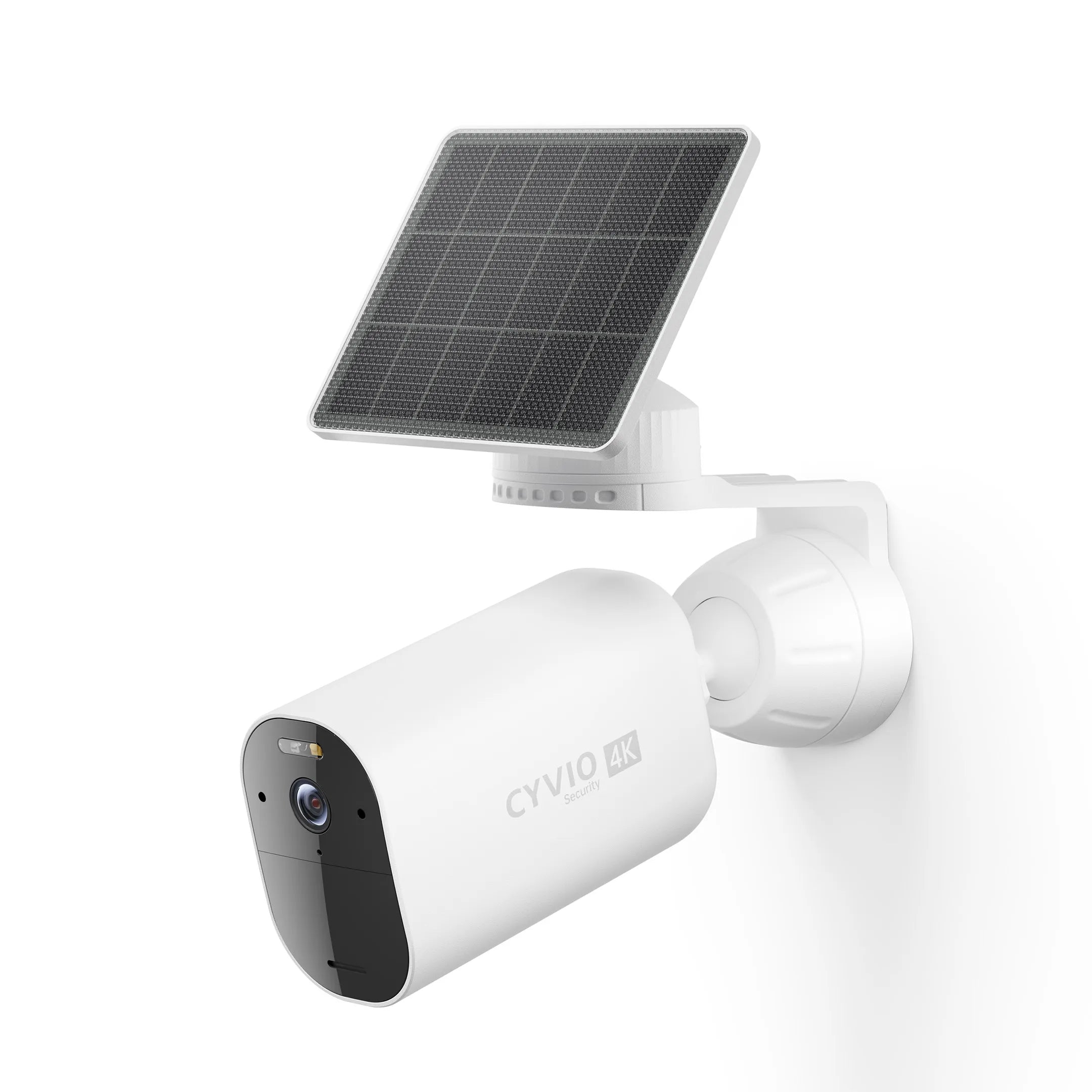
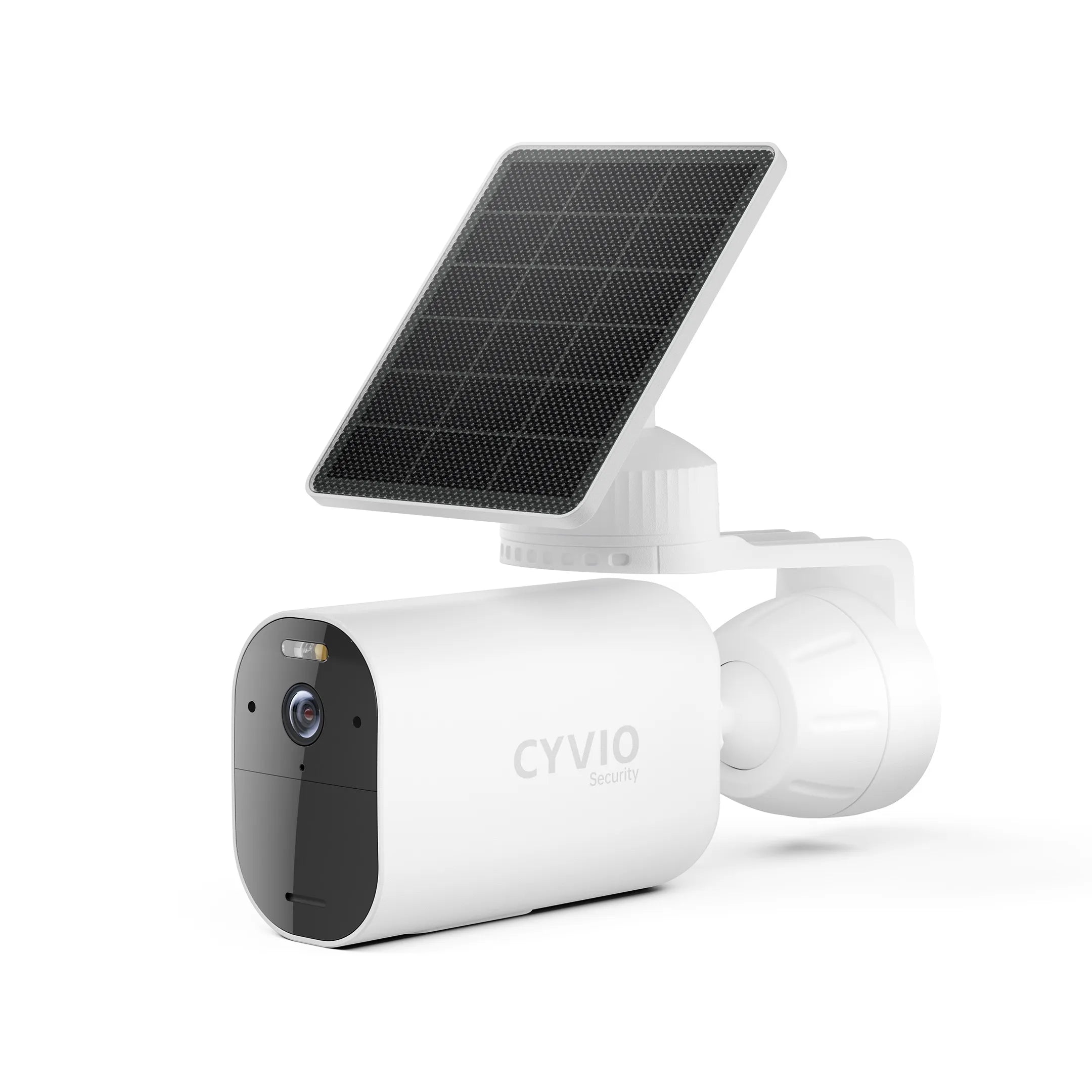
The CYVIO N1814 4K Solar Wireless Security Camera System combines rechargeable battery power with integrated solar charging.

Each camera includes an 11,600mAh rechargeable battery and a built-in solar panel. CYVIO states that, under its specified usage conditions, a single solar panel receiving approximately 2.5 hours of sunlight can provide energy corresponding to around seven days of operation. Actual results can vary according to sunlight, recording frequency, temperature, camera settings, and other installation conditions.
For winter use, this larger battery reserve can be useful because the camera can draw on stored energy during nights and periods of reduced solar input.
However, battery capacity does not remove the need to check temperature limits.
Is the CYVIO N1814 Suitable for Winter?
The answer depends on the winter conditions at the installation location.
CYVIO currently specifies an operating temperature range of:
0°C to 40°C (32°F to 104°F)
The N1814 also has an IP66 weather-resistance rating.
These specifications need to be considered separately.
IP66 indicates resistance to dust and water under the relevant test conditions, while the operating-temperature specification tells you the temperature range in which CYVIO specifies the device for operation.
Therefore, the N1814 can be considered for winter environments that remain within its stated temperature range.
If your location regularly experiences temperatures below 0°C / 32°F, those conditions fall outside the currently published operating-temperature specification for the N1814.
That distinction is particularly important when choosing equipment for regions with severe winters.
Other CYVIO N1814 Features Useful During Winter
Solar charging is only part of winter monitoring.
The N1814 records at 3840 × 2160 resolution and supports both infrared and color night vision, with CYVIO listing a night vision range of 15 meters.
Night vision becomes especially relevant during winter because daylight hours may be considerably shorter.
The system also supports:
-
Person and vehicle detection
-
Custom motion detection areas
-
Two-way audio
-
Scheduled recording
-
Continuous recording
-
Local storage
-
Expandable HDD storage
-
Long-range wireless communication
For properties such as larger yards, detached structures, farms, or warehouses, wireless range can also matter.
CYVIO specifies IEEE 802.11ah communication with a maximum transmission distance of 700 meters under open, interference-free conditions. Buildings, terrain, obstacles, and radio interference can reduce real-world range.
This combination allows battery power, solar charging, local recording, and long-range connectivity to be considered together rather than treating solar power as an isolated feature.
Mild Winter vs. Severe Winter: What Changes?
Not every winter creates the same operating conditions.
Mild Winter
A location may experience:
-
Temperatures mainly above freezing
-
Regular sunny days
-
Little snow
-
Moderate cloud cover
A solar camera installed within its specified temperature range may continue receiving useful solar energy throughout this type of winter.
The main adjustment may simply be shorter charging periods.
Snowy Winter
Frequent snowfall introduces additional concerns:
-
Snow covering the panel
-
More cloud cover
-
Longer periods of reduced sunlight
-
More maintenance
A larger battery reserve becomes more valuable because the camera may depend on stored energy for longer periods.
Very Cold Winter
When temperatures regularly fall below the camera's specified operating range, the decision changes.
The key question is no longer just solar charging.
You need a camera and battery system specifically rated for those temperatures.
For that reason, checking minimum operating temperature should come before comparing resolution, storage, or other features in severe cold climates.
When Might a Solar Camera Not Be the Best Winter Option?
Solar security cameras provide convenient installation in many locations, but some winter environments may favor another power solution.
Consider alternatives when:
-
The installation area receives very little winter sunlight
-
Dense trees shade the panel throughout most of the day
-
Snow frequently covers the panel for extended periods
-
Temperatures regularly fall outside the camera's specified operating range
-
Continuous high-power recording is required
-
Manual access to the panel is extremely difficult
If Ethernet cabling is practical, a PoE camera can remove battery and solar charging from the power equation.
The most suitable choice depends on the property rather than one camera technology being better for every situation.
Solar Camera Winter Checklist
Before winter begins, inspect your setup using the following points:
| Check | Why It Matters |
|---|---|
| Operating temperature | Confirms the camera is rated for your expected conditions |
| Winter sun exposure | Determines how much charging opportunity remains |
| Solar panel angle | Can influence winter sunlight and snow shedding |
| Panel cleanliness | Snow and debris can block incoming light |
| Battery level | Provides reserve during reduced solar input |
| Motion sensitivity | Excessive triggers increase energy consumption |
| Recording duration | Longer clips require more battery power |
| Night vision settings | Longer winter nights can increase nighttime energy use |
| Wireless connection | Stable communication supports reliable operation |
| Mounting condition | Wind, snow, and ice can stress outdoor hardware |
This type of seasonal inspection can help identify problems before prolonged winter weather arrives.
FAQ: Solar Security Cameras in Winter
Do solar powered security cameras work in winter?
Yes, they can work in winter when the camera remains within its specified operating conditions and the solar panel provides enough energy over time. Shorter days, cloud cover, snow, camera activity, and battery temperature can all affect performance.
Can solar security cameras charge in winter?
Yes. Solar panels generate electricity from available light rather than heat. Cold weather by itself does not stop solar charging, although shorter days, clouds, shade, and snow can reduce total daily energy production.
Do solar cameras work when it is cloudy?
They can still receive some solar energy under cloudy skies, but charging may be lower than during strong sunlight. The rechargeable battery supplies stored energy when solar generation is insufficient.
Will snow stop a solar security camera from working?
Snow on the solar panel can reduce charging, but the camera may continue operating from battery power while sufficient stored energy remains. Extended snow coverage becomes more important if the battery cannot recover its daily consumption.
Does snow damage solar camera panels?
Ordinary winter exposure depends on the construction and environmental rating of the specific product. Heavy snow and ice can place additional stress on solar equipment, so mounting and manufacturer specifications should be considered.
Do solar cameras need direct sunlight during winter?
Direct sunlight generally supports stronger charging, but solar panels can also generate some electricity from diffuse daylight. Total charging depends on sunlight intensity, duration, angle, shade, and weather.
Does cold weather drain a solar camera battery faster?
Low temperatures can reduce the usable capacity and power available from lithium-based batteries. Actual effects depend on battery chemistry and the specific camera design.
Can a solar camera work below freezing?
Only use a camera within the operating-temperature range specified by its manufacturer. Some outdoor camera systems are designed for subzero conditions, while others are not.
Can the CYVIO N1814 work below freezing?
CYVIO currently lists the N1814 operating range as 0°C to 40°C (32°F to 104°F). Temperatures below 0°C fall outside that published operating-temperature range.
Is IP66 enough for winter?
IP66 describes resistance to water and solid-particle ingress. It does not specify cold-temperature performance. Check the camera's IP rating and operating-temperature range separately.
Should I change my solar camera settings during winter?
It may be useful if battery levels decline. Adjusting unnecessary motion triggers, recording duration, spotlight use, or other power-intensive settings can reduce energy consumption.
How often should I check a solar camera during winter?
There is no fixed interval for every installation. Check the camera after heavy snowfall or significant weather changes and monitor battery levels periodically through the app or recording system when that information is available.
Conclusion: Do Solar Security Cameras Work in Winter?
So, do solar security cameras work in winter?
Yes, solar cameras can continue operating during winter when there is sufficient stored battery energy, useful daylight for recharging, and temperatures remain within the device's specified operating range.
Cold weather itself does not prevent photovoltaic cells from generating electricity. In many cases, the more significant challenges are shorter days, lower sun angles, clouds, snow covering the panel, longer nights, and reduced rechargeable-battery performance at low temperatures.
For a system such as the CYVIO N1814, an 11,600mAh rechargeable battery works together with built-in solar charging, while 4K video, infrared and color night vision, person and vehicle detection, local storage, and long-range wireless communication support outdoor monitoring.
However, winter suitability should always be evaluated against the actual product specifications. CYVIO lists the N1814 for operation between 0°C and 40°C (32°F and 104°F), so installations that regularly experience temperatures below freezing should consider a camera specifically rated for those colder conditions.
For winter solar monitoring, the most effective approach is to evaluate the entire system: sunlight exposure, battery capacity, operating temperature, snow accumulation, recording activity, night vision, and panel placement. When these factors match the installation environment, solar charging can remain a practical way to power outdoor security cameras through colder seasons.