









Do Solar Cameras Work at Night? How Solar Security Cameras See After Dark

If solar cameras depend on sunlight for power, what happens after sunset? Do solar cameras work at night, or does monitoring stop once the solar panel is no longer receiving sunlight?
Yes, solar security cameras can operate at night because the camera does not normally depend on real-time sunlight to stay powered. During the day, the solar panel converts sunlight into electricity and helps recharge a built-in battery. After sunset, the camera draws energy from that stored battery instead. Many models also include infrared or color night vision so they can capture activity in low-light conditions.
However, nighttime performance depends on more than simply having a solar panel. Battery capacity, daytime charging, recording frequency, night vision technology, temperature, wireless connectivity and camera settings can all influence how a solar camera performs after dark.
This guide explains how solar cameras operate at night, what happens when there is no sunlight, how infrared and color night vision differ, and what to consider when choosing a solar camera for nighttime monitoring.
How Does a Solar Security Camera Work?
A solar security camera combines three main systems: a camera, a rechargeable battery and a photovoltaic solar panel.
During daylight hours, photovoltaic cells in the panel convert sunlight into electrical energy. Part of that energy can support camera operation, while the charging system directs available power to the rechargeable battery.
The stored battery energy becomes particularly important at night.
After sunset, the solar panel stops or substantially reduces electricity generation because usable sunlight is no longer available. Instead of shutting down, the camera draws power from its battery.
This daytime charging and nighttime battery-use cycle is what allows solar cameras to operate beyond daylight hours.
Backstreet Surveillance similarly describes solar wireless cameras as systems in which the panel captures solar energy during the day and a rechargeable battery stores energy that can then support camera operation during nighttime or reduced-sunlight conditions.
So when asking do solar powered cameras work at night, the important component is not actually the solar panel at night—it is the battery that was charged during the day.
Check out this guide to learn more: What to Look for in a Home Security Camera
What Happens to a Solar Camera After Sunset?
A common misconception is that a solar-powered camera needs sunlight every moment it is running.
It does not.
Think of the solar panel as a charging source and the battery as an energy reservoir.
During daylight:
Sunlight → Solar panel → Electrical energy → Rechargeable battery
At night:
Rechargeable battery → Camera → Detection, recording, night vision and wireless communication
Because energy has already been stored, the camera can continue carrying out supported functions even when the panel itself is producing little or no power.
The exact nighttime behavior varies by model. Some battery cameras remain in a low-power standby state until motion is detected. Others offer more frequent monitoring modes. Systems designed for continuous recording generally require considerably more energy than event-based cameras.
Therefore, confirming that a camera "works at night" does not automatically mean that it records continuously throughout the entire night.
Read more on: Where to Place Security Cameras
How Can Solar Cameras See in the Dark?
Having enough battery power solves only one part of nighttime monitoring. The camera also needs a way to capture useful images when visible light becomes limited.
Most outdoor security cameras use one or both of the following technologies:
|
Night Vision Type |
How It Works |
Typical Image |
|
Infrared night vision |
Uses infrared LEDs to illuminate an area with light that is not normally visible to the human eye |
Usually black and white |
|
Color night vision |
Uses a sensitive image sensor, supplemental lighting, or a combination of both |
Color footage when conditions allow |
The right option depends on the environment and what details you want the camera to capture.
Infrared Night Vision
Infrared, or IR, night vision is widely used because it allows a camera to capture images even when visible ambient light is very limited.
Infrared LEDs positioned around the camera lens illuminate the scene using infrared wavelengths. The image sensor detects this reflected infrared light and creates a visible image.
Footage is generally displayed in black and white because monochrome processing can preserve useful contrast in very dark conditions.
Infrared night vision can be useful for areas such as:
Driveways, backyards, side entrances, detached buildings, storage areas and gates where nighttime lighting is limited.
One advantage is that IR illumination does not need a bright visible spotlight to illuminate the scene. However, image quality can still vary based on distance, lens design, weather conditions and objects reflecting infrared light.
Check out this guide: Security Camera Installation
Color Night Vision
Some solar cameras also provide color night vision.
Color night vision attempts to preserve color information after dark. Depending on the camera, this may rely on a low-light image sensor, built-in white light, a spotlight or a combination of technologies.
Color can provide additional visual context that black-and-white footage may not show as clearly. For example, it may make it easier to distinguish the color of clothing, a vehicle or another object when lighting conditions support it.
However, supplemental lighting consumes battery energy.
For solar battery cameras, this trade-off matters because using a spotlight frequently throughout the night can increase power consumption compared with lower-power standby operation.
Do Solar Security Cameras Work at Night Without Sunlight?
Yes, provided sufficient stored battery power is available.
The answer to do solar security cameras work at night is based on energy storage rather than nighttime solar generation. The panel charges the rechargeable battery when sunlight is available, and the battery supplies power after dark.
This is also why battery capacity is an important specification when comparing solar security cameras.
A larger battery can provide more stored energy, but capacity by itself does not determine how long a camera will operate. Power consumption can change considerably depending on recording behavior and enabled features.
A camera that detects only a few events each night may consume much less energy than one facing a busy road where vehicles and pedestrians trigger motion repeatedly.
How Much Battery Does a Solar Camera Use at Night?
There is no universal percentage of battery consumption per night.
Nighttime battery usage depends on the camera and its environment.
A quiet backyard camera may spend much of the night in a low-power state and wake only when motion is detected. A driveway camera facing frequent traffic may activate significantly more often.
Battery use can increase when the camera performs tasks such as recording longer clips, activating infrared LEDs, switching on a spotlight, sending notifications, streaming live video, processing person or vehicle detection, transmitting footage wirelessly or supporting two-way audio.
Temperature can also matter. Rechargeable batteries can behave differently under very cold or very hot conditions, so manufacturers' operating-temperature specifications should be considered for outdoor installations.
Instead of judging a solar camera only by battery capacity, consider the complete energy balance:
Energy collected during daylight vs. energy consumed throughout the day and night.
For stable long-term operation, solar charging needs to replenish enough of the energy that the camera consumes over time.
Want to understand the technology behind surveillance? Read more on: How Do Security Cameras Work?
What Happens After Several Cloudy Days?
Solar cameras do not necessarily stop operating simply because the sky becomes cloudy.
Solar panels may still produce electricity under diffuse daylight, although power generation is typically lower than under stronger direct sunlight.
The rechargeable battery provides a buffer during periods when charging conditions are less favorable.
However, if several low-sunlight days occur while the camera continues consuming substantial energy, battery charge can gradually decrease.
How quickly this happens depends on factors such as battery capacity, solar panel output, shading, recording activity, weather, camera settings and nighttime lighting.
This makes solar panel placement especially important.
A camera with a capable battery can still experience charging difficulties if its panel spends much of the day underneath trees, roof overhangs or other sources of shade.
Not sure how many cameras your home needs? Check out: How Many Security Cameras Do I Need?
Does the Solar Panel Need to Work at Night?
No. The solar panel itself does not need to generate electricity during the night for a battery-powered solar camera to function.
This distinction helps explain do solar powered cameras work at night more accurately.
The panel and camera perform different jobs. The panel collects energy when sunlight is available. The battery stores that energy. The camera draws from the battery when the panel cannot provide enough power.
This arrangement is similar to many other solar-powered devices that collect energy during daylight and use stored energy after sunset.
What matters at night is how much usable battery energy remains.
Motion-Activated Recording vs. Continuous Recording at Night
Another important distinction is how the camera records.
Many battery-powered solar cameras are designed around motion-triggered recording. The camera can remain in an energy-saving state until its sensor detects activity. It then wakes, records an event and may send a notification.
This approach helps conserve battery energy.
Continuous recording has very different power requirements because the image sensor, processor, storage system and wireless components may need to remain active for much longer periods.
A solar camera that supports motion recording should therefore not automatically be assumed to provide uninterrupted nighttime footage.
Before choosing a product, check whether its recording mode matches your monitoring needs.
If your priority is event detection around a gate, backyard, driveway or detached building, motion-based solar cameras can make practical sense.
If your project specifically requires continuous recording throughout every night, power consumption and storage requirements deserve much closer attention.
Does Night Vision Drain a Solar Camera Battery Faster?
Night vision requires energy, but the amount depends on the technology being used.
Infrared LEDs consume power when active. Visible spotlights used for color nighttime footage can also add to energy consumption.
The impact may be small during occasional motion events but more noticeable if the camera repeatedly activates throughout the night.
For example, a solar camera aimed at a quiet side entrance may activate only several times overnight. A camera positioned beside a busy sidewalk, moving vegetation or road traffic may trigger much more frequently.
Camera placement and detection settings can therefore influence battery life almost as much as battery specifications.
Adjusting motion zones, detection sensitivity and recording duration can help reduce unnecessary activations where those controls are supported.
How Does CYVIO N1814 Handle Nighttime Monitoring?
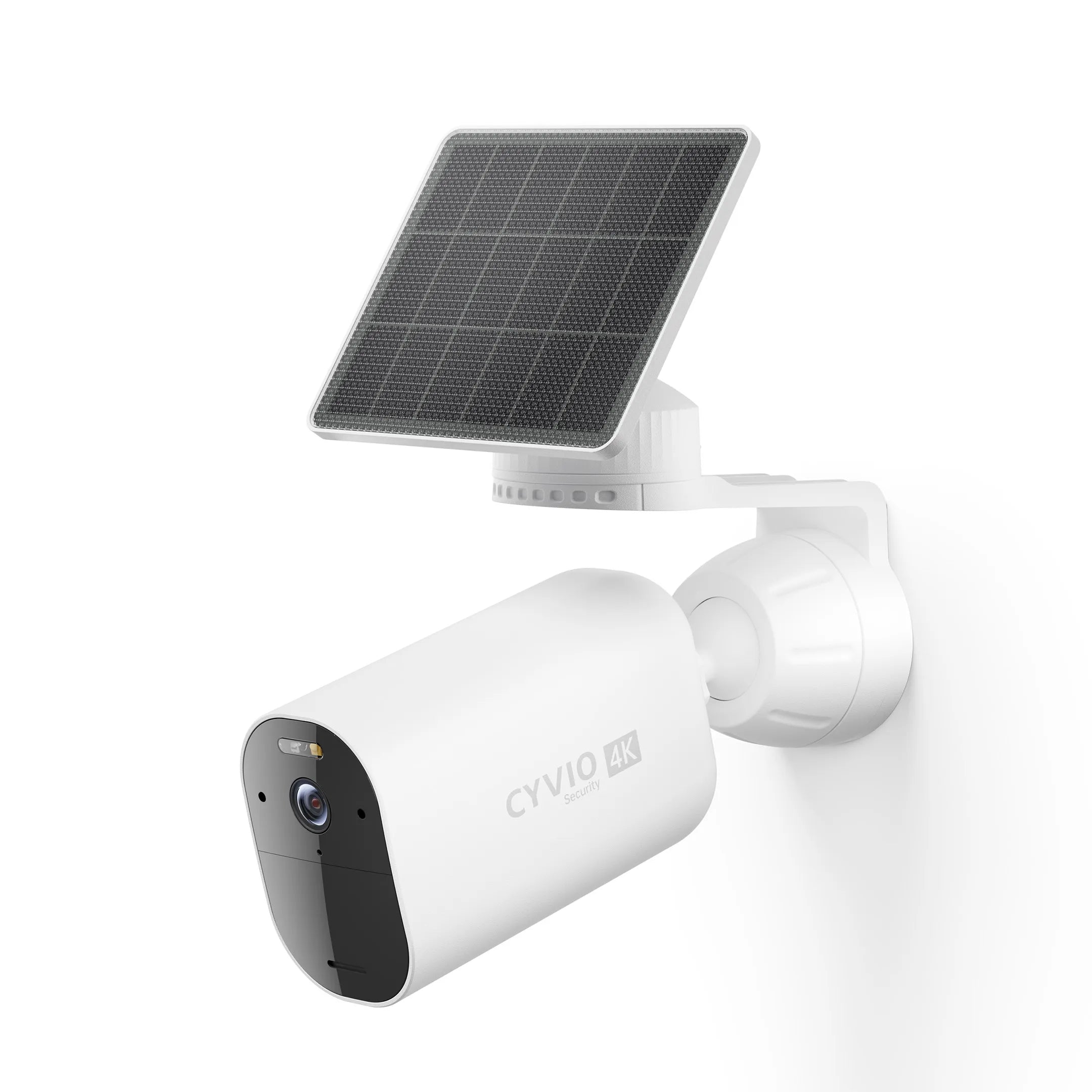
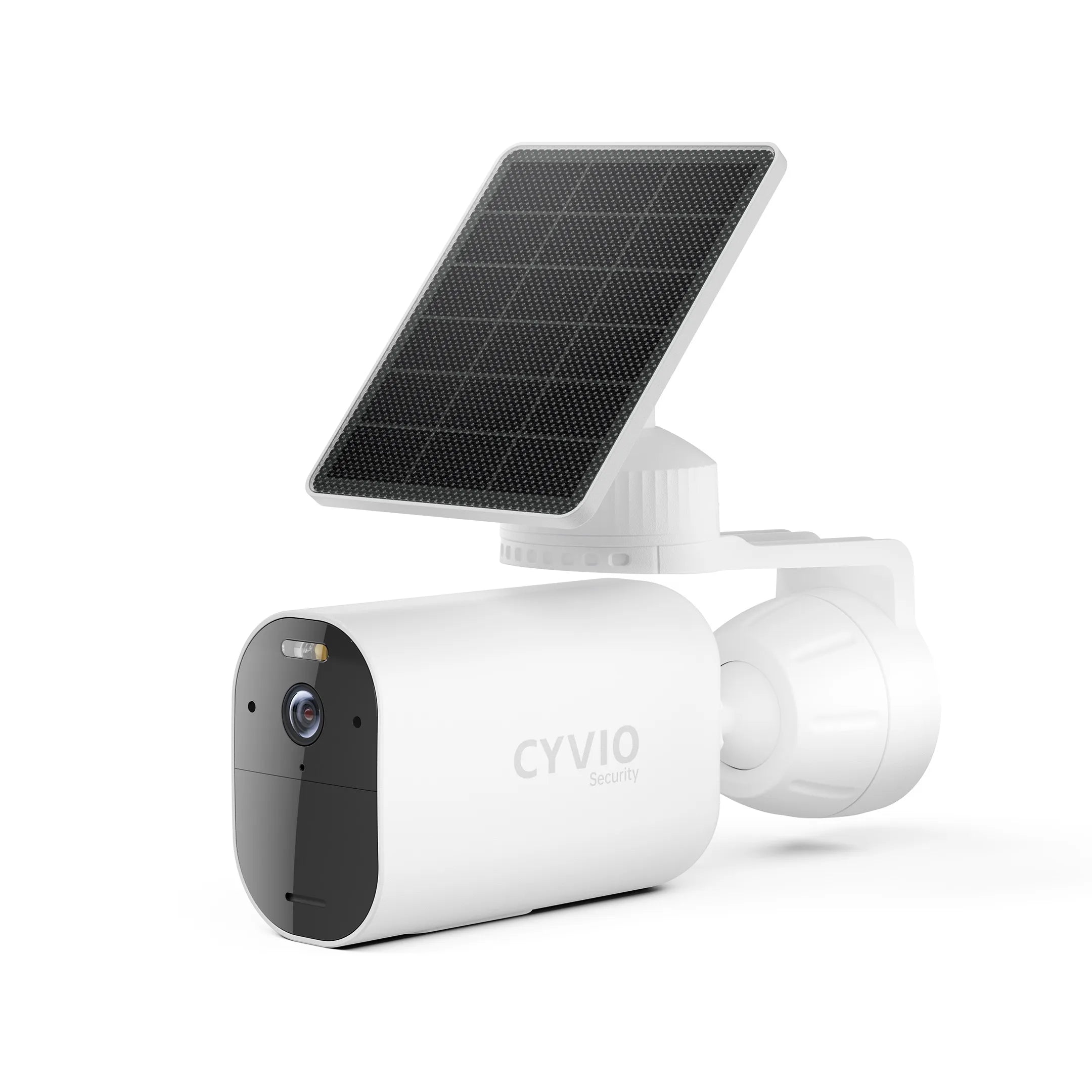
The CYVIO N1814 4K Solar Wireless Security Camera System provides a useful example of how battery power, solar charging and nighttime imaging can work together.

According to CYVIO's current product specifications, the N1814 cameras record at 3840 × 2160 resolution and support both infrared night vision and color night vision. CYVIO specifies a night vision range of up to 15 meters under its stated product specifications.
This gives users two different approaches to nighttime viewing. Infrared imaging can be used when ambient visible light is limited, while color night vision provides additional visual context when the camera's nighttime imaging conditions support it.
The N1814 cameras combine an integrated solar panel with an 11,600mAh rechargeable battery. The purpose of this arrangement is straightforward: daylight helps replenish the battery, while stored battery energy supports camera operation when solar generation falls, including after sunset.
That makes the N1814 relevant for locations where running a conventional power cable may be inconvenient, such as a detached garage, barn, driveway entrance, large yard or other outdoor monitoring point.
Long-Range Connectivity Can Matter at Night Too
Power is not the only consideration for a solar camera installed far from the house.
A camera may have sufficient battery charge and effective night vision but still provide a poor user experience if the wireless connection is unstable.
This can become particularly important on larger properties.
The CYVIO N1814 uses IEEE 802.11ah wireless communication. CYVIO lists a maximum transmission distance of 700 meters under open, interference-free conditions. Real-world distance can vary because walls, terrain, building materials, interference and installation conditions affect wireless signals.
This combination of solar/battery power and longer-range wireless communication is especially relevant for outdoor areas where both electrical wiring and conventional Wi-Fi coverage may be challenging.
What Can Affect Solar Camera Performance at Night?
Several factors determine whether a solar camera has enough stored energy and image quality for nighttime use.
Sunlight During the Day
Nighttime operation begins with daytime charging.
A panel installed where it receives useful sunlight can replenish substantially more energy than one positioned beneath dense vegetation or a deep roof overhang.
The sun's path also changes seasonally, so a position that receives strong sunlight in summer may become more shaded during winter.
Battery Capacity and Battery Condition
The rechargeable battery stores energy for periods when solar input is limited.
Capacity matters, but battery age and environmental temperature may also affect usable runtime.
Battery specifications should therefore be evaluated together with the camera's power requirements.
Number of Motion Events
Every recording event consumes energy.
A camera aimed at a low-traffic backyard may behave very differently from the same model pointed toward a street with regular pedestrian and vehicle movement.
False or unnecessary motion triggers can also increase power consumption.
Recording Duration
Longer clips require the camera's sensor, processor and storage functions to remain active for more time.
If customizable recording duration is available, users can balance event coverage with energy consumption according to the installation.
Night Vision Mode
Infrared and spotlight-based color modes have different energy requirements.
A camera that repeatedly activates a visible light throughout the night may consume more battery than one primarily using low-power standby with short IR-triggered recordings.
Live Viewing
Opening the camera frequently through an app may keep wireless transmission and video processing active.
Long live-view sessions can therefore consume additional energy.
Wireless Signal Quality
A difficult wireless environment can also affect overall efficiency.
When positioning a solar camera, consider both sunlight exposure and communication quality instead of optimizing only one of them.
Where Should You Install a Solar Camera for Better Nighttime Performance?
The best camera angle and the best solar charging position are not necessarily identical.
Ideally, the camera should have a clear view of the area you want to monitor while its solar panel receives sufficient daylight.
Avoid positioning the camera where nearby objects are likely to interfere with night vision. Walls, poles, gutters and reflective surfaces very close to infrared LEDs can sometimes cause infrared light to bounce back toward the lens and reduce image clarity.
For the solar panel, watch the intended installation location throughout the day before mounting the camera permanently.
Look for shadows created by trees, roofs, fences, chimneys and neighboring structures.
Nighttime monitoring begins with daytime energy collection, so solar exposure should be treated as part of the camera installation process rather than an afterthought.
Can a Solar Camera Work During a Power Outage at Night?
A solar battery camera does not rely on the home's electrical circuit in the same way as a standard plug-in camera.
If its rechargeable battery has sufficient stored energy, the camera itself may continue operating during a household power outage.
However, the entire security setup should be considered.
For example, if the camera relies on a home router and the router loses power, remote connectivity may become unavailable even if the camera remains powered.
Systems that use a recorder, base station or other networking equipment may have similar dependencies.
Therefore, camera power and network availability should be evaluated separately when planning for outages.
Do Solar Cameras Need Wi-Fi to Work at Night?
Solar power and wireless networking serve completely different functions.
Solar charging provides energy. Wi-Fi or another wireless protocol provides communication.
A solar camera can have enough battery to operate after dark without that automatically meaning remote access will remain available.
Depending on the system, wireless connectivity may be used for live viewing, notifications, video transfer or communication with a recorder.
Local storage can also affect what happens when connectivity is temporarily unavailable.
The N1814, for example, supports local storage through a microSD option and an internal HDD slot supporting storage expansion up to 8TB according to CYVIO's published specifications.
Can Solar Cameras See in Complete Darkness?
Cameras equipped with infrared night vision can capture images when visible ambient lighting is extremely limited because their IR LEDs provide illumination that the camera sensor can detect.
However, image quality is still affected by practical factors.
Night vision has a finite range. Objects farther away may appear less detailed. Rain, fog, insects, dust and reflective surfaces can also influence nighttime imagery.
Color night vision typically benefits from more available visible light or supplemental illumination.
For that reason, "night vision" should not be interpreted as producing exactly the same image quality as daytime recording.
When comparing cameras, evaluate resolution, night vision range, lens aperture, illumination method and intended viewing distance together.
Solar Cameras at Night: Common Misconceptions
One misconception is that a solar security camera switches off when the sun goes down. In reality, rechargeable batteries are designed to supply energy when solar generation is unavailable.
Another misconception is that moonlight powers the solar panel enough to run the camera normally. A security camera should instead be planned around energy collected during useful daylight hours and stored in its battery.
It is also incorrect to assume that any solar camera automatically records continuously throughout the night. Recording behavior depends on the product's design and settings.
Finally, a large solar panel alone does not determine nighttime performance. Battery capacity, energy consumption, camera activity, night vision mode and installation quality are all part of the equation.
How to Choose a Solar Camera for Night Use
If nighttime performance is a priority, look beyond the word "solar" in the product name.
First, check whether the camera offers infrared night vision, color night vision or both. Then examine the manufacturer's stated night vision distance and consider whether it matches the area you want to monitor.
Next, evaluate battery capacity and the solar panel arrangement. A strong energy reserve becomes more important in areas with long nights, frequent camera activity or inconsistent sunlight.
Camera resolution should also be considered. Higher resolution can preserve additional image detail, although nighttime image quality still depends on lighting, sensor performance and viewing distance.
For larger properties, wireless range deserves similar attention. A camera installed far from the house needs both adequate solar exposure and a suitable communication link.
Finally, review storage options and recording modes. Decide whether motion-triggered recording meets your needs or whether your application requires longer recording periods.
FAQ About Solar Cameras at Night
Do solar cameras stop working when the sun goes down?
No. A solar battery camera can draw energy from its rechargeable battery after sunset. The solar panel is primarily responsible for replenishing that battery when sunlight is available.
Do solar powered cameras work at night if the solar panel is not charging?
They can, as long as enough energy remains in the rechargeable battery. The solar panel does not need to generate electricity at the same moment the camera is operating at night.
How do solar security cameras see at night?
Depending on the model, they may use infrared LEDs, low-light sensors, visible spotlights or combinations of these technologies. Infrared footage is commonly displayed in black and white, while color night vision attempts to retain color information.
Can solar cameras record all night?
It depends on the camera. Some models focus on motion-triggered recording to conserve battery energy, while other systems may support longer recording modes. Check the manufacturer's recording specifications rather than assuming every solar camera operates continuously.
Will a solar camera work after a cloudy day?
It may continue operating using stored battery energy. However, cloudy weather generally provides less favorable charging conditions than strong sunlight, so prolonged low-sunlight periods combined with heavy camera usage can reduce the battery level.
Does infrared night vision use battery power?
Yes. Infrared LEDs and the camera's imaging components consume energy while active. The amount depends on the device, recording duration and frequency of nighttime events.
Does color night vision use more power?
It can, particularly when the camera activates a visible spotlight or supplemental lighting. Actual consumption depends on the camera's design and settings.
How far can a solar camera see at night?
There is no single distance for all cameras. Night vision range varies according to the model, lens, sensor and illumination system. For example, CYVIO specifies a night vision range of 15 meters for the N1814.
Conclusion: Do Solar Cameras Work at Night?
So, do solar cameras work at night? Yes—solar battery security cameras can continue operating after sunset by using energy stored in their rechargeable batteries during periods of available sunlight.
The solar panel handles energy collection, the battery stores that energy, and night vision technology helps the camera capture activity in low-light conditions.
However, nighttime performance depends on the complete system. Daytime sunlight exposure, battery capacity, motion frequency, recording length, infrared or color night vision, temperature and wireless connectivity can all influence how effectively the camera performs after dark.
For installations where both nighttime visibility and flexible outdoor placement matter, systems such as the CYVIO N1814 combine solar charging and rechargeable battery power with 4K video, infrared and color night vision, a specified 15-meter night vision range and long-range IEEE 802.11ah connectivity.
Choosing the right solar camera therefore is not simply about finding a model with a solar panel. It is about matching its battery, charging capability, night vision, recording behavior and wireless system to the environment where it will actually be used.